Sunday, May 24, 2009

Sunday morning song

I am a firm believer in lazy Sunday mornings.


I realize that this is probably because for the past few years, lazy Sundays have not existed for me. Especially during my time in San Francisco, I was working nearly every Sunday for at least a few hours, and oftentimes much longer than that.

During my last year of college, Sunday was the one day of the week when I didn't work or have multiple dance classes (only one class on Sundays, you see, and that was the rehearsal when I was the choreographer). My Sundays that year were comprised of quality time in my school's dark room in the mornings and early afternoons before dance rehearsal around dusk. Then I'd head home to have some dinner and study. They were lovely days, though a bit too filled and scheduled to be my ideal.

Every other Sunday here in Louviers, I am cleaning, doing mise en place and then helping Susan serve the students their Welcome Dinner while hanging out with F. Not the lazy Sunday of my dreams, but we've been really good about going for bike rides and swims these past few weeks as the weather has warmed up, so I'm not complaining.

Today, however, well, today is my kind of Sunday. I got up, tidied the kitchen a bit and hung some laundry out on the line before heading to the bakery for a brioche to dunk every so delicately in my morning milky tea. I then curled up on the couch and read for an hour in perfect silence.

Mornings like this one don't come nearly often enough.

But I love them when they do.

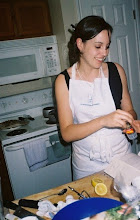
I don't have a recipe for you today, but I would steer you in the direction of the link Molly put up recently on rhubarb compote. Except that I would tell you to take some direction from this lovely lady and leave out the orange liquor and throw in a touch of pure vanilla extract. It's heavenly.

Now go enjoy your Sunday.

Saturday, May 9, 2009

On school and simplicity


Cooking school provides opportunities where entire evenings are completely devoted to making three different cookie doughs, rolling them out into logs, wrapping them in parchment paper and slipping them neatly into plastic bags to be refrigerated, then later frozen. Those white logs sitting side by side in the refrigerator are more than enough to make a girl feel proud.

And of course, a half log snuck out of line, sliced up and baked, yielding midnight black sablés to be eaten in between batches with a glass of wine...well that's one of life's best and simplest pleasures.

I've been thinking a lot about how I eat recently (that probably comes as no great surprise), and I've discovered that simpler things really do satisfy me.

I had a phenomenal dinner last night that consisted of steamed asparagus, tossed with olive oil and thinly sliced, quickly blanched, spring onions. The whole mess was then showered with grated aged goat cheese and left alone for about 10 minutes for the cheese to melt slowly over the still-warm asparagus and onions. Then we took it outside with some cut up bread and ate to our heart's content, enjoying the mild weather, view of the church and the great company.

That's the kind of dinner I want to eat all the time.

Wednesday, May 6, 2009

Its perfect complement

My my, but it has been awhile.


Unfortunately, I seem to be saying that rather frequently in this space as of late, but this job has been keeping me quite busy. We just finished up a wonderful 3-day class here in Louviers and starting tomorrow we have three classes in two days in Paris.

The week before, my mother came to visit and help celebrate my birthday, and we had a lot of fun. From a degustation in a tiny underground cave to navigating French highways in a stick shift van to drinking a white Languedoc while watching My Fair Lady...well, we did it up right.


We took trips to Rouen and Honfleur, and had many a walk around Louviers, which was showing off by flowering blooms everywhere.


We also managed to do quite a bit of cooking together, with my mother discovering the wonders of pre-roasted beets in salads and broiled mackerel with tangy lime/soy vinaigrettes. I think I also may have created a fellow addict to a phenomenal Turkish yogurt that I get at a little Kosher grocery store in town. That stuff is like yogurt crack.


And as it happens, its perfect complement is my grandmother's famous rhubarb crunch recipe, which we prepared mid-week.


I say famous, because this is one of my favorite desserts of all time, and was a staple in my house growing up. So...I suppose it's famous only in the Douglas household, but it really should be in yours as well.

Rhubarb Crunch
Adapted from Agnes Douglas

1 cup flour
1 cup brown sugar
1 tsp. cinnamon
1/2 cup butter, cut into rough cubes
3/4 cup oats
4 cups fresh rhubarb, any leaves removed, chopped into 1 inch pieces
1 cup sugar
1 cup water
2 Tbs. cornstarch
1 tsp. vanilla

Preheat the oven to 350 degrees. Grease a 9' X 9' glass pan with butter.

Place the flour, brown sugar, cinnamon and oats into a medium mixing bowl. Use your hands to toss and mix them together. Add the butter pieces and use your fingers to thoroughly incorporate the butter into the oat mixture. To do this, you'll want to squish the butter cubes and dry ingredients between your fingers, rolling them a bit until you no longer have any large butter chunks.

Place the sugar, water, cornstarch and vanilla into a medium saucepan and warm over medium heat. Cook, stirring frequently, until the sugar is dissolved and the sauce has begun to thicken up.

Press half of the oat and butter mixture into the bottom of the pan. Top with the cut rhubarb slices, then drizzle the sugar water over the rhubarb. Layer the remaining half of the oat and butter mixture on top, taking care to evenly cover the rhubarb underneath.

Bake for 1 hour, or until bubbling around the edges.

Serves 2 throughout an entire week. Under normal circumstances, serves 12-16.

Note: You want to try this fresh out of the oven with some vanilla ice cream. Trust me on this one.

Wednesday, April 15, 2009

Snippets and snapshots

I'm not sure how I missed my lesson on steamed vegetables, but I am more than making up for lost time, let me tell you.

I remember reading somewhere that the French steam their vegetables more than lots of other cultures. Please don't ask me where, as I have been reading snippets and snapshots of so many different books and cookbooks scattered around the house that my head is feeling a tad bit spin-y at the moment.


Everything fell into place, however, when Susan and I picked up a bouquet of asparagus for the first time at the market last week (from Baptiste, of course).

We had said goodbye to our guests (a small class of three Dutch women in for the weekend) then immediately retreated to our bedrooms for a nap, much to Susan's daughter's (herein referred to as "F") dismay. After I woke up, F and I headed to the hyperChampion to pick up some supplies and give Dusty a bit of a walk.


When we came back, Susan had woken up and put out some gorgeous rust-colored sun-dried tomatoes and some basil-scented goat cheese for dipping, as well as a towering platter of freshly steamed asparagus, accompanied by Piment d'Espelette Fleur de Sel.

Following Susan's lead, I dipped the asparagus ends into the spicy salt and bit in.

Oh, there's nothing like that first taste of honest to goodness spring produce. I love celery root and cabbage as much as (maybe even more than) the next person, but I need seasonal changes to keep me from overdosing on them. Spring vegetables are not only wonderful in their own right, but in the promise of summer stone fruit and berries that they bring with them.


Instead of a firm recipe, I'm going to do a quick tutorial on steaming today. Maybe none of you need it, but I certainly did when I was assigned to steam some beets the other day for lunch (so delicious!).

You'll need a vegetable steamer basket and a large saucepan for this operation. Fill the bottom of the saucepan with a half inch or so of water, then put in the steamer basket to make sure the water isn't coming over the top-you want the water level just below the steamer basket, so add or remove water as necessary. Take out the basket and bring the water to a boil, then carefully return the basket to the pan.

If you're doing a vegetable that steams quickly such as asparagus, then leave the heat up high and dump your asparagus in. Just make sure to snap the ends off of the asparagus (yes, you have to do it individually, and don't worry--the asparagus will snap where it needs to, naturally separating the woody stalk) before putting it in. Steam for just a few minutes, until the asparagus is tender but not limp.

For a sturdy vegetable like beets, you'll follow the same general operation as above with a few notable exceptions.

First of all, peel and cube your beets or sweet potatoes or what have you. Set up the pot, as above, but once the water comes to a boil, lower the heat a bit to medium or medium-high. Put in your cubed vegetables, then cover. These vegetables will take quite a while to steam, anywhere from 30-50 minutes, but you'll need to check the water level every 10 minutes or so, adding more as necessary to ensure that you're not burning the basket and pan (I find that a Pyrex liquid measuring cup is really handy here). The vegetables are done when you can stick a sharp knife in the middle of a cube and feel no resistance.

Beets are especially good done this way when when you toss them with a bit of sherry vinegar, salt and pepper.

P.S. I apologize for my lack of actual food pictures in recent posts. Working in the kitchen constantly has not been conducive to snapping photos all the time. I'll work on making up for it in the coming weeks!

Sunday, April 5, 2009

Missed the boat

I want to let you all know up front that this will be a bit of a short post. I just got done with a cooking class from the weekend and am still recovering, even after an hour nap today!

Onward...

I just don't understand why we're so afraid of desserts in the States.

No, wait, I take that back.

I guess what I don't understand is how we could be so scared to have a dessert on a regular basis. I do it here, and have not suffered any ill effects. It's a puzzle, part of the French paradox maybe...or maybe it's just because we've missed the compote boat.

One of the things that Alice Waters continually preaches is how lovely a perfect fresh piece of fruit is--the ideal dessert, really. Sometimes, however, some of us don't have access to that lovely piece of perfect fruit, or, let's be honest, we get sick of plain fruit and want a little spice in our life.

That brings us to this lovely apple compote I've made a couple of times over the past few weeks. It's the end of the apple season here in Louviers, so I'm gobbling up as many apples as possible, in any form I can think of.

A compote is essentially cooked down fruit, as far as I can tell. Some versions tell you to cook the fruit in a sugar syrup, and you can absolutely do that if you like, but here in France, a compote is kind of a sister to applesauce. It is eaten hot and cold, brought in as a base for a buttery tart and very happily married with flaky pastry for chaussons aux pommes.

Sometimes simplicity is best, and that means tossing cubed, peeled apples into a pot with sugar and some vanilla and calling it dessert.

Apple Compote
Adapted from Farmhouse Cookbook by Susan Herrmann Loomis

6 medium-sized firm apples, such as Cox's Pippin
2 Tbs. butter
1/2 Tbs. grapeseed or canola oil
1/2 tsp. pure vanilla extract
2 tsp. (vanilla) sugar
Freshly grated nutmeg
Squeeze of fresh lemon juice (optional-add in before serving if you've got less of a sweet tooth)

Peel, core and cube the apples.

Melt the butter and oil together over medium heat in a medium saucepan. Once melted, add the apple cubes and stir. Add the vanilla and nutmeg, stir and turn down the heat to medium-low.

Stir periodically until the apples are soft, about 20 minutes. Use a potato masher to mash about half of the apples in the saucepan (you want to leave some big chunks for texture), stir again and serve.

Serves 2-3.

This is great all on its own, and I encourage you to mix it up with other spices such as cinnamon or a touch of pepper. This would also be lovely with ice cream, I imagine, maybe vanilla or cinnamon.

Saturday, March 28, 2009

Pre-roasted

I have a new best friend and her name is Dusty.

Dusty and I have been getting along splendidly during the past week and a half while I've been house-sitting for Susan and looking after her daughter. A few times a week we go on runs, always interspersed with short stops if Dusty find something particularly luscious to sniff or needs to, shall we say, mark her territory.

Otherwise, I try to make sure that we get in two walks a day.

At the beginning, I always had her on a leash, my head filled with visions of screeching tires and honking cars. I quickly noticed that Dusty had a habit of going off around town on her own, and found out that the leash was, in fact, a new thing for her. Dusty has incredibly good common sense, and is quite at ease in town, weaving in and out of traffic and looking both ways before crossing the street (I swear, I have seen her do it!).

Do I still get uneasy about it? Absolutely.

But if she was on a leash all of the time, I'd never have the chance to be taken on a walk by her. Which is what happens at least once a day.


Dusty will trot ahead of me, maybe 20 feet or so, investigating corners and doorways, periodically looking back at me to make sure I'm following her. If I ever decide to turn down a certain street or turn around to head back home, I just have to wait for her to glance back again, which she does every 45 seconds or so, motion to her with a quick nod, and head in the new direction. She will immediately join me, galloping out front so that she will again be leading the charge.

During the time when I'm working at my desk in my room, she can be found at least half the time on the floor near me, waiting for me to finish so that we can go on another walk.


Dusty always comes to the market with us, though she's probably the only dog there not on a leash. Like I said, she's quite the city dog, and people seem to know her well, and not mind too much if she slips back behind the stalls to try and find a scrap of something or other.

Myself, I've been spending my market time waiting patiently in line for my current addiction: endives.


I've seared them and topped them with an olive-oil fried egg for a light lunch on a cold and rainy day (of which there have been quite a lot this past week). But my current favorite way is sliced and tossed in a salad with roasted beets.

Did you know that until recently, you could never find raw beets at the markets here? Everyone always bought them pre-roasted to save themselves the trouble of roasting at home.

I wasn't sure what I was going to do with the roasted beet that Baptiste slipped into my bag last week. He suggested cubing it and tossing it with a simple vinaigrette, and while that sounded lovely, I took it one step further by combining it with fresh apples, cheese and nuts...oh, and one of his gorgeous endives.


This salad is ideally suited to variations. In the past three days I've had it in as many different ways: once with beets, pears and comté, another day with beet, endive and apple, and the third day using the recipe below. Note that this is a rough outline, and I encourage you to play with proportions and ingredients.

Beet and Endive Salad

1 medium to large endive
1 1/2-inch thick slice of peeled, roasted beet*
1 medium apple (I've been using Jonagold or Cox's Orange Pippin)
1 1/2-inch thick hunk of parmesan (I'd guess around 1 oz)
Handful of pumpkin seeds
1 tsp. sherry vinegar
3 tsp. good olive oil
Sea salt
Freshly ground pepper

Remove any yellowing leaves from your endive and slice the very end of the stem off. Thinly slice the endive horizontally into slices about 1/4 inch thick.

Cube the beet and parmesan into bite-size pieces (about 1/2 inch by 1/2 inch).

Peel, core and cube the apple into bite-size pieces.

Combine the endive, beet, parmesan, apple and pumpkin seeds in a bowl and toss to mix. Add the sherry vinegar, olive oil, salt and pepper and toss again to thoroughly combine. Don't worry if your salad starts to get a little pink--which it will, thanks to the beet--just enjoy eating pink food!

Enjoy with some good bread and maybe a glass of dry white wine like a Sancerre or Pinot Blanc.

Serves 1

*If you need to roast the beet yourself, do as follows:
Preheat your oven to 400 degrees F. Cut off your beet tops, leaving about 1/2 an inch of the stem still attached to the beet root, and reserve (they're fabulous sautéed in just a bit of olive oil). Scrub the beets and place them in a baking pan. Add enough water to come up the sides of the pan 1/4 inch. Cover the pan tightly with a lid or aluminum foil and roast until the beets are easily pierced through with a knife. This can take anywhere from 40 minutes and beyond, depending on the size of your beets. Once cooled, use your thumb to nudge off the beet skin and discard.
Oh, and wear an apron! Beet juice can stain your hands and your cutting board, but don't let it stain your shirt!!

Wednesday, March 25, 2009

On the cake

Periodically--it seems to be about once a month--Susan hosts a friendly neighborhood wine tasting at her home.


For the event last week, I gathered about 14 stools around the kitchen island, put out lots of silver and 32 plates (one plate each for the shepherd's pie, salad and cheese and the others for dessert) with a nice blue trim and searched out the four boxes of tasting glasses in the back prep kitchen.

I was downstairs tidying up the kitchen when Baptiste walked in, his black curls bouncing everywhere, loaded up with a huge bag of his very tasty mache. I finished unloading the dishwasher after a friendly two kiss greeting, and he got to work washing the mache in the zinc vegetable sink.

Baptiste is one of my favorite farmers at the weekly market. His vegetables are incredible, usually arriving about a week earlier than anyone else and always tasty. We split our vegetable shopping between his stand and another run by an adorable older couple. But our endive? Those, we always buy from Baptiste.

Just a few weeks ago, while Susan was spending her week teaching in Paris and I was holding down the fort at home with the animals (except for two days of classes, when I took the train in to assist), I ate up our supply of four endive in salads inspired by this recipe. When she returned, we went to the Saturday market as usual and I was surprised that Susan didn't pick up any more endive. I figured maybe the season was over, or maybe she wasn't as much of a fan as I was, but I didn't say anything, not having had my coffee and croissant yet.

Days later, I heard my name called from the kitchen, and I went downstairs. There was Susan, visibly heartbroken at the idea that she wouldn't be able to eat any of Baptiste's endive until she returned home from her trip to the states weeks later. I couldn't decide whether to laugh or crawl under the kitchen island. I don't think she could either.


That night at the wine tasting, after finishing with the dishwasher, I came to take over washing duties from Baptiste, and he politely but firmly nudged me out of the way and continued his work. That, of course, didn't bother me a bit, until I happened to glance down at the mache floating in the sink.

On my first or second day here, Susan had shown me the proper way to wash and serve mache (bought at Baptiste's stand, bien sur). It takes anywhere between 5 and 7 washings, depending on how dirty it is, which can take quite a while, but you can't skimp for fear of allowing a single piece of grit to slip past your guard and onto an unsuspecting diner's plate.

She had also stressed that mache should be left in the little florets it grows in, so you can imagine my shock and horror when I saw that Baptiste, while washing his mache, had cut off all of the leaves from every floret, leaving them all swimming individually in the sink.

Knowing that there was nothing I could do to save the already massacred mache at this point, I casually mentioned Susan's theory of leaving the mache whole to Baptiste, who grinned at me, shrugged, then commented that seeing as it was his mache and he didn't care, neither should anyone else.

I knew someone else wasn't going to have quite the same point of view, and rushed upstairs to warn Susan so that she wouldn't faint at the sight of those desolate mache leaves.

Earlier that day I had baked and iced a cake for dessert. We had a glutton of carrots on hand, so Susan decided that I should try a carrot cake, a version from her delightfully stained and dog-eared copy of her own Farmhouse Cookbook.


This is not the fluffy, cream cheese frosting-swirled carrot cake of your youth, however. This is a down-home, thick, almost fruit cake-esque cake, full of warm spices and walnuts.

And did I mention that I topped it with a caramel frosting?

Whoa. I mean, the cake was good, though it probably would've been better if left to sit for a few days and have the flavors meld and marry a bit more, but that frosting was out of this world.

Imagine a (slightly) salted butter caramel melted all over a dense, nutty cake and you'll be getting warmer.

It was all I could do not to get out a spoon and eat the entire pan full myself, and it must be said that I was not overly pleased when Susan called in her daughter to help me lick the spoon after I had finished frosting the cake. I'm good at sharing, really I am, just not when there's caramel frosting to be finished.

I imagine that this would go equally well with white or chocolate cakes. Because of its thickness, I also think it'd be great on any kind of pound cake or spiced bundt cake. Come to think of it, I can't really imagine it not going well with anything, even an ice cream sundae.

Caramel Frosting
Adapted from Farmhouse Cookbook by Susan Herrmann Loomis

1 stick (8Tbs) unsalted butter
1/2 cup brown sugar, packed
2 Tbs. milk
1 cup plus 2 Tbs. confectioners' sugar*
1/2 tsp. pure vanilla extract

Melt the butter in a medium saucepan over medium heat. Once melted, add in the brown sugar and reduce the heat to low. Stir frequently with a wooden spoon until the sugar melts and is fully incorporated, about 2 minutes.

Stir in the milk, then raise the heat to medium. Continue stirring until the mixture just comes to a boil, then remove the pan from heat and cool slightly.

Once the mixture is lukewarm, whisk in the confectioners' sugar 1/2 cup at a time. Fully incorporate each portion of sugar before adding in the next one. At this point, the frosting shoud be smooth and free of lumps.

Whisk in the vanilla extract, then spread the frosting immediately over your cake.

Yields 1 cup, just enough for the top of a 10-inch bundt cake, with pretty drips down the side.

*If you run out of confectioners' sugar or just don't have any on hand, grind up your regular sugar to a very fine dust in a coffee grinder (clean it first!). You can add a touch of cornstarch as well, but I didn't this time, and the frosting was still unbelieveable. Just remember to measure the sugar after it's been ground, not before.